
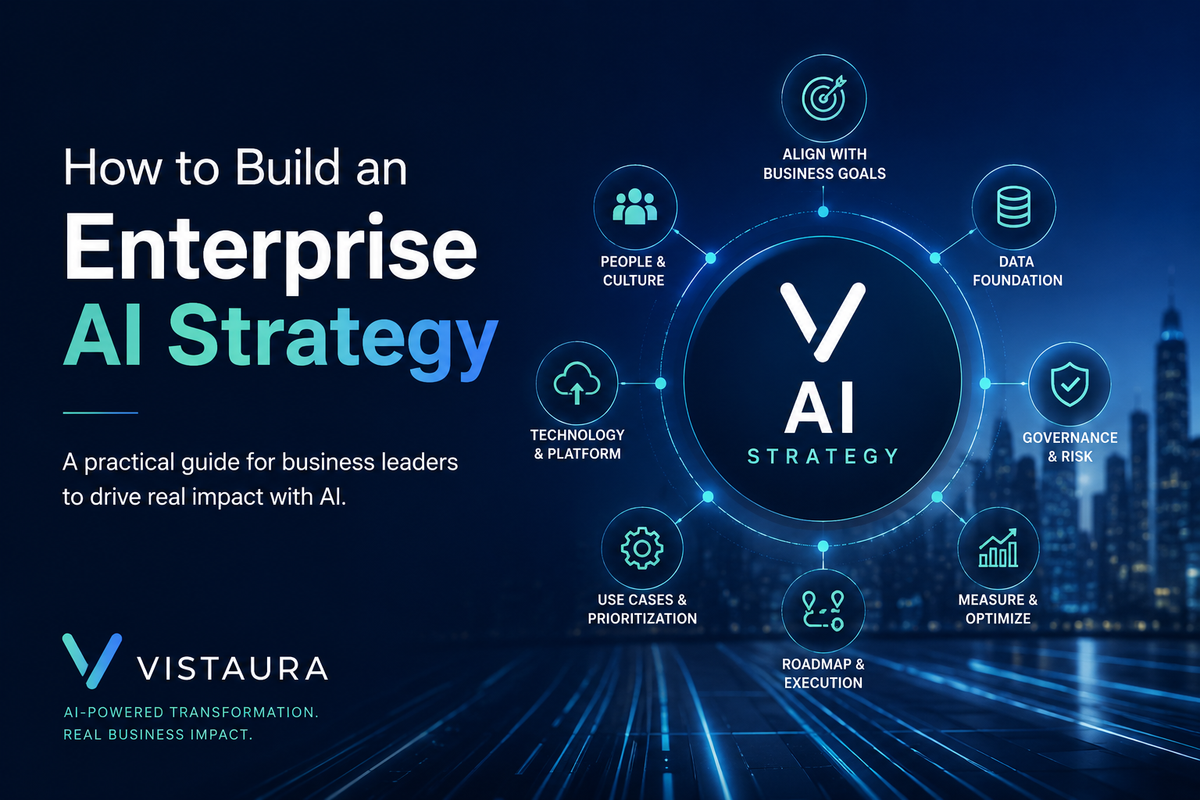
How to Build an Enterprise AI Strategy: A Practical Guide for Business Leaders

Artificial Intelligence has moved beyond experimentation. The organizations creating measurable business value from AI are not necessarily the ones with the most advanced technology—they are the ones with a clear enterprise AI strategy.
In many organizations, AI initiatives begin with isolated pilots, departmental experiments, or technology-driven projects. While these efforts often generate excitement, they rarely scale into sustainable business outcomes without a structured strategy.
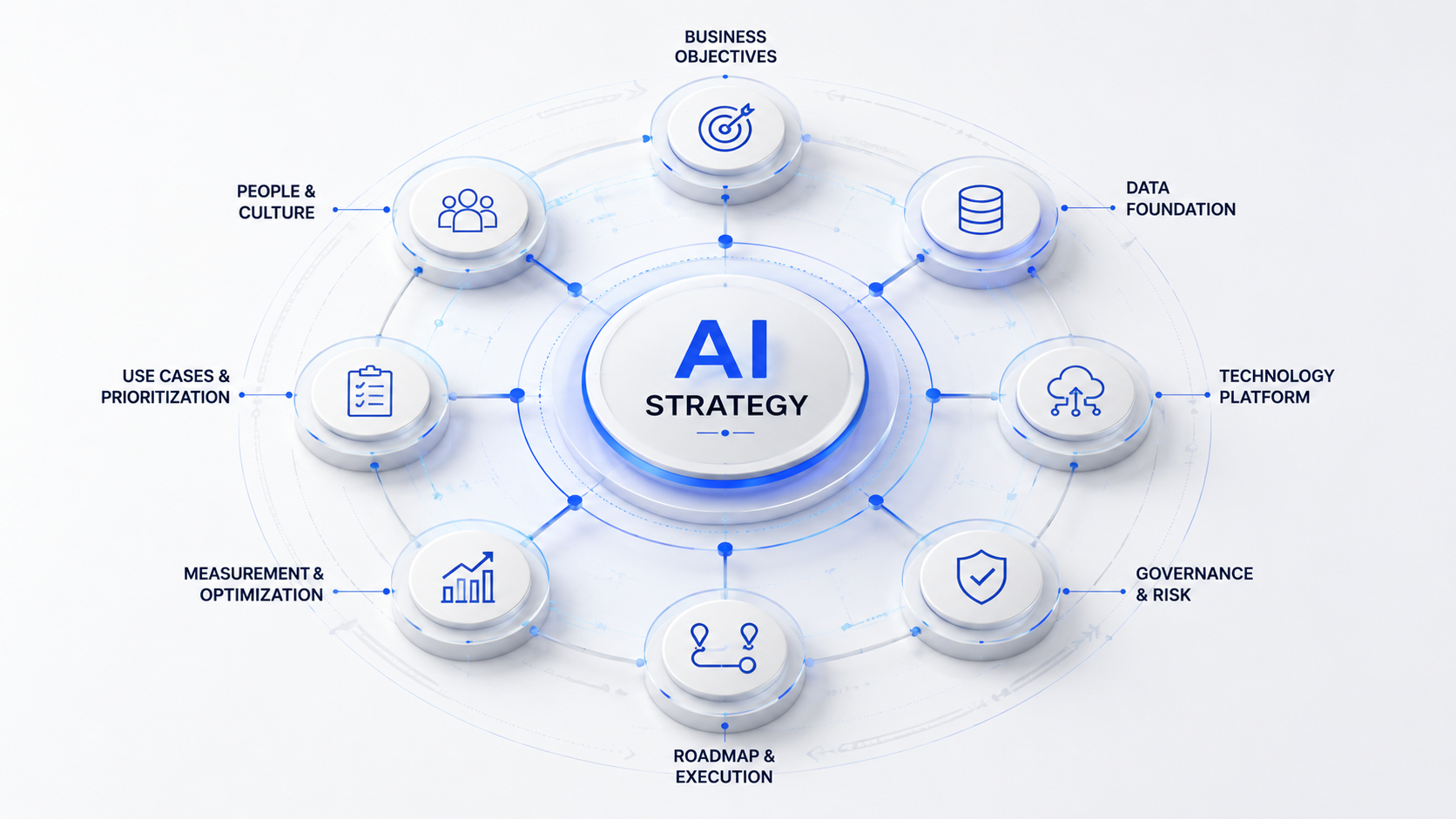
An enterprise AI strategy provides the roadmap that aligns AI investments with business objectives, operational priorities, and long-term growth goals.
In this guide, we explore the key components of building an effective enterprise AI strategy and how organizations can move from experimentation to enterprise-wide impact.
Why an Enterprise AI Strategy Matters
Many organizations rush into AI adoption because competitors are doing so, vendors are promoting new technologies, or leadership teams feel pressure to "implement AI."
Without a clear strategy, organizations often encounter challenges such as:
- AI projects that never move beyond pilot phases
- Lack of measurable business outcomes
- Fragmented technology investments
- Poor data quality and governance
- Low employee adoption
- Increased security and compliance risks
A well-defined AI strategy helps organizations focus on business outcomes rather than technology trends.
The objective is not simply to deploy AI—it is to create sustainable business value.
Step 1: Align AI with Business Objectives
The most successful AI initiatives begin with business goals, not technology.
Before evaluating platforms, models, or vendors, organizations should identify the business challenges they are trying to solve.
Common strategic objectives include:
Operational Efficiency
- Automating repetitive processes
- Reducing operational costs
- Improving productivity
Revenue Growth
- Enhancing customer experiences
- Personalizing offerings
- Identifying new market opportunities
Risk Reduction
- Improving compliance monitoring
- Detecting fraud
- Strengthening cybersecurity
Decision Intelligence
- Improving forecasting accuracy
- Enhancing planning processes
- Accelerating decision-making
Organizations that clearly define business objectives create a stronger foundation for AI investment decisions.
Step 2: Assess Organizational Readiness
Before launching large-scale AI initiatives, organizations should evaluate their current capabilities.
Key readiness areas include:
Leadership Alignment
- Executive sponsorship
- Strategic commitment
- Funding support
Data Readiness
- Data quality
- Data accessibility
- Governance frameworks
Technology Infrastructure
- Cloud capabilities
- Data platforms
- Integration architecture
Talent and Skills
- Data engineering
- Analytics expertise
- AI governance capabilities
Change Management
- Employee readiness
- Training programs
- Adoption planning
Understanding current maturity levels helps organizations identify gaps before scaling AI initiatives.
Step 3: Identify and Prioritize AI Use Cases
Not every business challenge requires artificial intelligence.
Organizations should focus on use cases that provide measurable business value while remaining technically feasible.
A practical prioritization framework evaluates opportunities based on:
Business Impact
Potential value creation through:
- Cost savings
- Revenue growth
- Risk reduction
- Productivity gains
Feasibility
Evaluation criteria include:
- Data availability
- Technical complexity
- Integration requirements
- Regulatory considerations
Time to Value
Organizations should balance:
- Quick wins
- Medium-term improvements
- Long-term strategic initiatives
A structured use-case portfolio helps maintain momentum while building organizational confidence in AI.
Step 4: Build a Strong Data Foundation
AI systems are only as effective as the data that powers them.
Many organizations discover that their greatest challenge is not AI implementation but data readiness.
Key areas of focus include:
Data Quality
Reliable and accurate data sources.
Data Integration
Connecting enterprise systems and eliminating information silos.
Data Governance
Policies governing access, security, privacy, and compliance.
Enterprise Knowledge Management
Creating structured access to organizational knowledge and expertise.
Organizations that invest in their data foundation are significantly more likely to achieve long-term AI success.
Step 5: Establish AI Governance
As AI adoption grows, governance becomes increasingly important.
An effective governance framework helps organizations:
- Manage risk
- Ensure compliance
- Maintain transparency
- Build stakeholder trust
Key governance considerations include:
Responsible AI
- Fairness
- Transparency
- Explainability
Security
- Data protection
- Access control
- Model security
Compliance
- Industry regulations
- Privacy requirements
- Auditability
Model Lifecycle Management
- Monitoring
- Performance management
- Continuous improvement
Governance should be embedded into AI programs from the beginning rather than introduced after deployment.
Step 6: Develop an AI Operating Model
Scaling AI requires more than technology.
Organizations need a structured operating model that defines how AI initiatives are managed across the enterprise.
Typical components include:
Executive Leadership
Strategic direction and funding.
AI Center of Excellence (CoE)
Governance, standards, and best practices.
Business Functions
Identification and ownership of AI opportunities.
Technology Teams
Infrastructure, integration, and platform management.
Data Teams
Data engineering, governance, and analytics.
A well-defined operating model enables consistent execution and long-term scalability.
Step 7: Execute Through a Phased Roadmap
Successful AI transformation occurs through incremental progress rather than large-scale disruption.
A phased roadmap typically includes:
Phase 1: Discovery and Assessment
- Business alignment
- Readiness assessment
- Opportunity identification
Phase 2: Pilot Programs
- Quick-win initiatives
- Proof of value
- Stakeholder engagement
Phase 3: Scale and Integrate
- Enterprise deployment
- Process integration
- Workforce enablement
Phase 4: Continuous Optimization
- Performance monitoring
- Governance refinement
- Expansion into new use cases
This approach helps organizations demonstrate value while managing risk.
Common Mistakes to Avoid
Organizations frequently encounter challenges when AI initiatives are driven solely by technology considerations.
Common mistakes include:
Starting with Technology Instead of Business Problems
AI should solve business challenges rather than exist as a standalone initiative.
Ignoring Data Quality
Poor data often undermines otherwise promising AI projects.
Lack of Executive Sponsorship
Without leadership support, AI initiatives struggle to scale.
Underestimating Change Management
Technology adoption depends on people, processes, and organizational readiness.
Chasing Too Many Use Cases
Focusing on a small number of high-value opportunities typically delivers better outcomes.
The Future of Enterprise AI Strategy
As AI technologies continue to evolve, organizations will increasingly move beyond automation toward intelligent decision-making and agent-driven operations.
The organizations that succeed will be those that treat AI as a business transformation initiative rather than a technology project.
An enterprise AI strategy provides the structure needed to align investments, manage risk, and create measurable business value at scale.
The question is no longer whether organizations should adopt AI—it is how effectively they can build the capabilities required to compete in an AI-driven future.
Ready to Build Your Enterprise AI Strategy?
Every organization's AI journey is unique. Building a successful strategy requires alignment between business objectives, technology capabilities, data foundations, and operational readiness.
At Vistaura, we help organizations assess AI readiness, identify high-impact opportunities, build transformation roadmaps, and scale AI initiatives responsibly across the enterprise.
Contact our team to discuss how your organization can develop a practical and scalable enterprise AI strategy.

Offering strategic advice, solutions, and implementation support to help clients leverage technology effectively to achieve business objectives.